
Ethiopia Natural Sidamo

Call me Mr. Natural
If coffee drinking were a religion, Ethiopia would be the Holy Land. The coffee faithful would trek there, like the annual hadj of Mohammedans to Mecca.
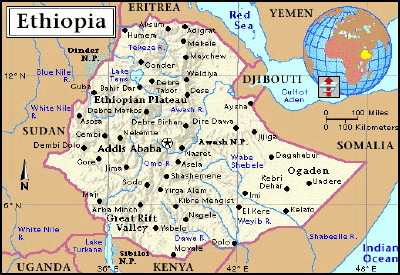
In the Sidamo province of southern Ethiopia, where the Great Rift system lifts the north-eastern African plateau above 5,000 ft., the species coffea originated. It was from here that ancient traders, identities shrouded in the mists of time, ferried plants across the Red Sea to establish the first coffee farms on the arid mountainsides of southern Arabia, today’s Yemen.
Today, coffee from Ethiopia comes in many forms. Some is still gathered from the wild trees where it grows. These are known as natural or unwashed coffees. Other Ethiopian coffees are processed according to the latest commercial methods. “Yirgacheff” and “washed Sidamo” are two of these. Somewhere in between are the coffees of Harar (and other regions) which while cultivated are still processed by the “dry” or “natural” method.
The salient difference between “washed” and unwashed coffees is that the fruit pulp of the former is washed off the seed after picking, instead of the pulp being left on to dry naturally. The objective of washing is to eliminate the chance of off-tastes from overripe or fermented coffee cherries marring the flavor of the “bean”. The goal isa “cleaner” (and more uniform) cup.
Unwashed or “dry” processing permits the cherries to dry completely before the seed is milled from the outer pulp and skin. This affords a prolonged contact between the ripe fruit and the seed, and imparts a fruitier, more complex and wine-like coffee flavor.
This is more than a religious argument. Dry processing takes more time, space, and labor, but comparatively little capital. The washed method accords with European and American mild taste preferences, and also with intensive agriculture methods, scale economics, and mechanized processes.
 Most specialty coffees are “washed”. The major source of unwashed arabicas is Brazil, but they are often flawed and sour in the cup. Premium unwashed coffees are produced in Yemen, Ethiopia, and Sumatra. Among Ethiopian coffees, the Harar Moka and the unwashed Sidamo are the best known naturals. Ethiopias are the basis for more than one Coffee Works blend.
“I think coffee is different in Ethiopia from anyplace else. It is something truly important for us, something that touches us inside and that we respect. Also, there is a huge sense of coffee as the life’s blood of our nation. Coffee is All, and with it we as people sink or swim together.” Abdullah Bagersh
Addis Ababa (3rd Generation) Exporter
Ethiopian coffees are known for certain taste traits: a “wildness” in the flavor, high acidity, full body, and distinctive fruitiness. The unwashed coffees have an earthiness or “vegetative” flavor. Above all however they are known for possessing an abundance of distinctive and undiluted coffee character.
Our selection this month is a longtime favorite, a natural Sidamo. This coffee has everything you look for in good Ethiopias; rich full body and bright, raw flavor.
The flavor is as exotic as the land. Try it for the exhileration of an unbalanced natural character.

